Operator and Gateway Overview
There are four primary deployments that comprise wasmCloud in a Kubernetes system:
- wasmCloud Operator — watches for workload CRDs and schedules Wasm workloads onto hosts
- Runtime Gateway — routes incoming HTTP traffic to deployed Wasm workloads
- Host Group — a pool of pods running cluster hosts (washlets) that execute Wasm components
- NATS — message broker providing the control-plane transport between the operator and hosts
Architecture
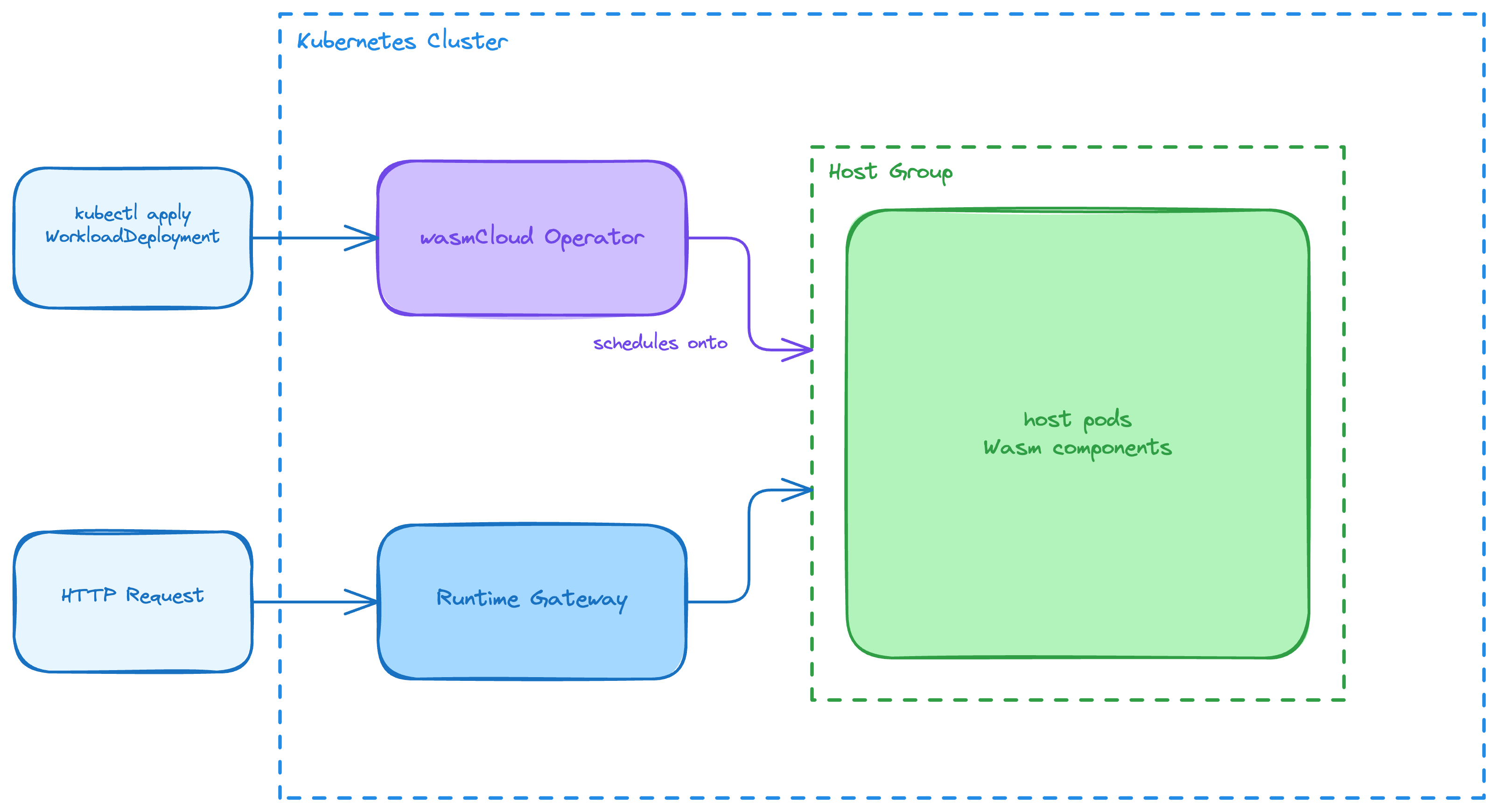
wasmCloud operator
The wasmCloud operator (runtime-operator) is the control-plane entity that watches for wasmCloud CRDs and reconciles the desired state. Its responsibilities include:
- Watching CRDs: Monitors
WorkloadDeployment,WorkloadReplicaSet,Workload,Host, andArtifactresources across all (or configured) namespaces. - Scheduling workloads: Reads the
WorkloadDeploymentspec and selects aHostthat matches thehostSelectorcriteria, then creates the appropriate child resources to run the Wasm component. - Host communication: Sends workload start/stop requests and polls host health over NATS, using the
runtime.host.<hostID>.<operation>subject pattern (e.g.runtime.host.<hostID>.workload.start). - Status reporting: Updates the
statussubresource of each CRD to reflect whether scheduling succeeded or failed, and surfaces Kubernetes events for observability. - Leader election: When enabled and running with multiple replicas, uses a
coordination.k8s.io/v1Lease in the operator's own namespace to elect a single active instance and avoid split-brain reconciliation. - Metrics endpoint: Exposes a
/metricsendpoint (Prometheus format) protected by Kubernetes token review and subject access review, suitable for scraping by monitoring tools.
The operator runs with the wasmcloud-runtime-operator ServiceAccount. See Roles and Role Bindings for the full set of permissions required.
Runtime Gateway
The Runtime Gateway acts as a reverse proxy that routes incoming HTTP traffic to the appropriate Wasm workload running on a host. Its responsibilities include:
- Traffic routing: Listens on a configurable port and forwards HTTP requests to the Wasm component that registered the matching route.
- Host discovery: Watches
HostandWorkloadCRDs (read-only) to maintain an up-to-date routing table as workloads are deployed or removed. - Service integration: Exposed via a Kubernetes
Service, allowing you to configureNodePort,LoadBalancer, orClusterIPaccess depending on your environment.
The gateway runs with the wasmcloud-runtime-operator-gateway ServiceAccount, which has read-only access to Host and Workload resources. It cannot modify cluster state.
Host group
The host group is a Deployment of pods, each running cluster hosts (washlets). A host group provides the sandboxed execution environment for WebAssembly components. Key characteristics:
- Multiple hosts per group: Multiple pods can form a single host group, allowing the operator to spread or replicate Wasm workloads across them.
- Host labels: Each pod is labelled (e.g.,
hostgroup: default) so thatWorkloadDeploymentmanifests can usehostSelectorto target a specific group. - Isolation: Each host is an isolated sandbox; components on different hosts do not share memory or state.
- Extensibility: You can build custom host images that include host plugins to extend the capabilities available to Wasm components.
By default, the Helm chart installs three host pods in the default host group.
NATS
NATS is the message broker that carries all control-plane traffic between the wasmCloud Operator and wasmCloud hosts. Key roles include:
- Operator ↔ host RPC: The operator sends workload start, stop, and status requests to individual hosts via NATS subjects (
runtime.host.<hostID>.workload.start,runtime.host.<hostID>.workload.stop, etc.). - Host self-registration: Each host pod publishes periodic
HostHeartbeatmessages toruntime.operator.heartbeat.<hostID>. The operator subscribes to these to discover hosts and create or update theirHostCRDs. - JetStream: Provides built-in object storage used by the platform.
The Helm chart bundles NATS with JetStream enabled (nats.enabled: true by default). To use an existing NATS cluster, set nats.enabled: false and configure the operator and hosts to point at your endpoint.
Request flow
When a WorkloadDeployment is applied:
- The wasmCloud operator detects the new CRD, selects a matching host from the host group, and sends a workload start request to the host via NATS (
runtime.host.<hostID>.workload.start). - The operator updates the
WorkloadDeploymentstatus to reflect the scheduling outcome. - The Runtime Gateway observes the new
Workloadresource via the Kubernetes API and adds a routing rule for HTTP traffic. - Incoming HTTP requests hit the Gateway's Service, which forwards them directly to the appropriate host pod (by pod IP), where the wash runtime executes the Wasm component.
Related documentation
- Custom Resource Definitions (CRDs) — describes the
WorkloadDeployment,Host,Workload, and other resources - Roles and Role Bindings — details the RBAC permissions required by the operator and gateway
- Filesystems and Volumes — how to mount volumes into host pods
- Private Registries — how to pull Wasm component images from private OCI registries
- CI/CD — integrating wasmCloud workload deployments into CI/CD pipelines