Deploy a Wasm Workload to Kubernetes
In our previous tutorials, we started a developer loop and added the wasi:keyvalue interface to our application. The wash dev process satisfied our application's capability requirements automatically, so we could move quickly and focus on code.
Now we'll learn how to:
- Compile your application to a WebAssembly component binary
- Publish your Wasm binary to an OCI registry
- Set up a wasmCloud environment on Kubernetes and deploy your Wasm workload
This tutorial assumes you're following directly from the previous steps. Make sure to complete Quickstart and Develop a WebAssembly Component first.
Build Wasm binary
- Rust
- TypeScript
- My language isn't listed
Use the wash build command from the root of a project directory to compile the component into a .wasm binary:
wash buildBy default, the compiled .wasm binary for a Rust project is generated at /target/wasm32-wasip2/release/. The output path for the compiled .wasm binary can be configured via wash's config.yaml file.
Use the wash build command from the root of a project directory to compile the component into a .wasm binary:
wash buildBy default, the compiled .wasm binary for a TypeScript project is generated at /dist/. The output path for the compiled .wasm binary can be configured via wash's config.yaml file.
If you prefer working in a language that isn't listed here, let us know!
Publish image
Now we can publish a Wasm binary image to any OCI compliant registry that supports OCI artifacts.
The wasmCloud ecosystem uses the OCI image specification to package Wasm components—these images are not container images, but conform to OCI standards and may be stored on any OCI-compatible registry. You can learn more about wasmCloud packaging on the Packaging page.
Authenticate to registry
wash uses Docker credentials for OCI registry authentication. For GitHub Packages (GHCR), you'll need a GitHub Personal Access Token (PAT) with write:packages scope. Authenticate with the docker CLI:
docker login ghcr.io -u <username>Docker will prompt you for your PAT as the password.
Your GitHub username (and the namespace in image paths) must be all lowercase.
Push image to registry
Now we'll push a Wasm component image to a registry. The example below uses GitHub Packages, but you can use any OCI compliant registry that supports OCI artifacts.
If you're following along using GitHub Packages, make sure to replace <namespace> in the command below with your own GitHub namespace (lowercase).
- Rust
- TypeScript
- My language isn't listed
wash oci push ghcr.io/<namespace>/http-hello-world:0.1.0 ./target/wasm32-wasip2/release/hello_world.wasmwash oci push ghcr.io/<namespace>/http-hello-world:0.1.0 ./dist/http_hello_world_hono.wasmIf you prefer working in a language that isn't listed here, let us know!
- The registry address (including name and tag) is specified for the first option with
wash oci push. - The second option defines the target path for the component binary to push.
If you're using GitHub Packages, remember to make the image public in order to follow the steps below.
Install wasmCloud on Kubernetes
Installation requires the following tools:
For more information on running wasmCloud on Kubernetes, see Kubernetes Operator.
Select your Kubernetes environment:
- Existing cluster
- kind
- k3d
- k3s
If you already have a Kubernetes cluster, skip cluster creation. Verify your kubectl context is pointing to the right cluster:
kubectl cluster-infokind runs Kubernetes nodes as Docker containers.
On Linux, Docker may require sudo unless you've completed the post-installation steps to run Docker as a non-root user.
The following command downloads a kind-config.yaml from the wasmCloud/wasmCloud repository, starts a cluster with port 80 mapped for ingress, and deletes the config upon completion:
curl -fLO https://raw.githubusercontent.com/wasmCloud/wasmCloud/refs/heads/main/deploy/kind/kind-config.yaml && kind create cluster --config=kind-config.yaml && rm kind-config.yamlk3d runs a lightweight k3s cluster inside Docker.
On Linux, Docker may require sudo unless you've completed the post-installation steps to run Docker as a non-root user.
The --port flag maps host port 80 to NodePort 30950 on the server node. The hello-world manifest used later in this tutorial exposes the workload as a NodePort Service on port 30950, so this maps the Wasm component directly to localhost:80 without going through k3d's bundled Traefik LoadBalancer:
k3d cluster create wasmcloud --port "80:30950@server:0"If you'd prefer the LoadBalancer pattern more typical of k8s production deployments, see the Expose a Workload via Kubernetes Service recipe.
k3s is a lightweight Kubernetes distribution. Linux only.
Install k3s:
curl -sfL https://get.k3s.io | sh -Configure kubectl to use the k3s cluster:
mkdir -p ~/.kube
sudo cp /etc/rancher/k3s/k3s.yaml ~/.kube/config
sudo chown $USER ~/.kube/config
Use Helm to install the wasmCloud operator:
The tutorial below routes HTTP traffic through a Kubernetes Service whose EndpointSlice the operator manages directly. The earlier Runtime Gateway that proxied traffic to workloads is deprecated (since 2.0.3) and will be removed in a future release; the local-dev overlay (values.local.yaml) disables it by default.
- Existing cluster
- kind
- k3d
- k3s
helm install wasmcloud --version 2.10.1 oci://ghcr.io/wasmcloud/charts/runtime-operator \
  --namespace wasmcloud --create-namespace \
  -f https://raw.githubusercontent.com/wasmCloud/wasmCloud/refs/heads/main/charts/runtime-operator/values.local.yaml
The values.local.yaml file configures each host's HTTP listener on port 80. The kind cluster config maps container port 30950 to host port 80, so any NodePort Service on port 30950 will be reachable at localhost:
helm install wasmcloud --version 2.10.1 oci://ghcr.io/wasmcloud/charts/runtime-operator \
  --namespace wasmcloud --create-namespace \
  -f https://raw.githubusercontent.com/wasmCloud/wasmCloud/refs/heads/main/charts/runtime-operator/values.local.yaml
The k3d cluster was started with host port 80 mapped to NodePort 30950 on the server node. That NodePort matches the nodePort: 30950 in the hello-world Service applied later in this tutorial, so requests to localhost:80 reach the workload directly:
helm install wasmcloud --version 2.10.1 oci://ghcr.io/wasmcloud/charts/runtime-operator \
  --namespace wasmcloud --create-namespace \
  -f https://raw.githubusercontent.com/wasmCloud/wasmCloud/refs/heads/main/charts/runtime-operator/values.local.yaml
k3s includes a built-in load balancer (Klipper) that binds LoadBalancer services to node ports:
helm install wasmcloud --version 2.10.1 oci://ghcr.io/wasmcloud/charts/runtime-operator \
  --namespace wasmcloud --create-namespace \
  -f https://raw.githubusercontent.com/wasmCloud/wasmCloud/refs/heads/main/charts/runtime-operator/values.local.yaml
Wait for the deployment to be ready:
kubectl rollout status deploy -l app.kubernetes.io/instance=wasmcloud -n wasmcloudDeploy Wasm workload
We'll deploy the Wasm application with two resources: a Kubernetes Service that receives HTTP traffic, and a WorkloadDeployment that references the Service and tells the operator to schedule the component onto a host. The operator maintains an EndpointSlice for the Service pointing at the host pods running the workload, so standard Kubernetes DNS and routing reach the component directly.
wasmCloud components are deny-by-default: a component cannot use any capability—HTTP, key-value storage, logging, or any other—unless the host is explicitly told to allow it. The hostInterfaces field in a workload manifest is the allowlist. Each entry names an interface package that the host will make available to the component. Any interface not listed is silently unavailable, regardless of what the component's WIT file imports.
Run the following script in your terminal to create a file called deployment.yaml containing both manifests.
- Existing cluster
- kind
- k3d
- k3s
cat > deployment.yaml << 'EOF'
apiVersion: v1
kind: Service
metadata:
  name: http-hello-world
spec:
  type: ClusterIP
  ports:
    - port: 80
      protocol: TCP
---
apiVersion: runtime.wasmcloud.dev/v1alpha1
kind: WorkloadDeployment
metadata:
  name: http-hello-world
spec:
  replicas: 1
  template:
    spec:
      hostSelector:
        hostgroup: default
      kubernetes:
        service:
          name: http-hello-world
      components:
        - name: http-hello-world
          image: ghcr.io/<namespace>/http-hello-world:0.1.0
      hostInterfaces:
        - namespace: wasi
          package: http
          interfaces:
            - incoming-handler
        - namespace: wasi
          package: keyvalue
          interfaces:
            - atomics
            - store
EOFcat > deployment.yaml << 'EOF'
apiVersion: v1
kind: Service
metadata:
name: http-hello-world
spec:
type: NodePort
ports:
- port: 80
protocol: TCP
nodePort: 30950
---
apiVersion: runtime.wasmcloud.dev/v1alpha1
kind: WorkloadDeployment
metadata:
name: http-hello-world
spec:
replicas: 1
template:
spec:
hostSelector:
hostgroup: default
kubernetes:
service:
name: http-hello-world
components:
- name: http-hello-world
image: ghcr.io/<namespace>/http-hello-world:0.1.0
hostInterfaces:
- namespace: wasi
package: http
interfaces:
- incoming-handler
config:
host: localhost
- namespace: wasi
package: keyvalue
interfaces:
- atomics
- store
EOFcat > deployment.yaml << 'EOF'
apiVersion: v1
kind: Service
metadata:
name: http-hello-world
spec:
type: LoadBalancer
ports:
- port: 80
protocol: TCP
---
apiVersion: runtime.wasmcloud.dev/v1alpha1
kind: WorkloadDeployment
metadata:
name: http-hello-world
spec:
replicas: 1
template:
spec:
hostSelector:
hostgroup: default
kubernetes:
service:
name: http-hello-world
components:
- name: http-hello-world
image: ghcr.io/<namespace>/http-hello-world:0.1.0
hostInterfaces:
- namespace: wasi
package: http
interfaces:
- incoming-handler
config:
host: localhost
- namespace: wasi
package: keyvalue
interfaces:
- atomics
- store
EOFcat > deployment.yaml << 'EOF'
apiVersion: v1
kind: Service
metadata:
name: http-hello-world
spec:
type: LoadBalancer
ports:
- port: 80
protocol: TCP
---
apiVersion: runtime.wasmcloud.dev/v1alpha1
kind: WorkloadDeployment
metadata:
name: http-hello-world
spec:
replicas: 1
template:
spec:
hostSelector:
hostgroup: default
kubernetes:
service:
name: http-hello-world
components:
- name: http-hello-world
image: ghcr.io/<namespace>/http-hello-world:0.1.0
hostInterfaces:
- namespace: wasi
package: http
interfaces:
- incoming-handler
config:
host: localhost
- namespace: wasi
package: keyvalue
interfaces:
- atomics
- store
EOFThe manifest has two resources: a Kubernetes custom resource (WorkloadDeployment) that describes the workload, and a standard Service. The fields to highlight in the WorkloadDeployment:
hostSelector.hostgroup: Selects which pool of wasmCloud hosts runs this workload. The Helm chart installs three host pods labelledhostgroup: default—this is the correct target for most deployments. Custom host groups can be created to isolate workloads or provide specialized capabilities.kubernetes.service.name: References the Service by name. The operator creates and maintains an EndpointSlice for this Service that points at the host pods running the workload, and registers the Service's DNS names (http-hello-world,http-hello-world.default,http-hello-world.default.svc) with the host's HTTP router. For local development,config.host: localhostis added so the component also answers requests whoseHostheader islocalhost.components.image: Defines the registry address we will use to fetch our Wasm image.hostInterfaces: Declares which capability interfaces the host will make available to the component. Without an explicit entry here, the component cannot access that capability. Since the HTTP and key-value capabilities use well-known built-in interfaces, all we have to do is list them.
Open the file and update the image name with the correct registry address. If you're using GitHub Packages, that means replacing <namespace> with your GitHub namespace.
Now use kubectl to apply the manifest:
kubectl apply -f deployment.yamlVerify that the Wasm component is successfully deployed:
kubectl get workloaddeploymentsUse curl to invoke the Wasm workload with an HTTP request:
OrbStack manages port 80 on macOS, intercepting traffic before it reaches the cluster. Run a port-forward in a separate terminal:
kubectl port-forward svc/http-hello-world 8080:80Then substitute localhost:8080 for localhost in the hello-world command, and use -H "Host: blobby.localhost.direct" http://localhost:8080/... in place of http://blobby.localhost.direct/... in the Blobby commands further below.
curl localhostHello x1, World!Deploy the Blobby file server
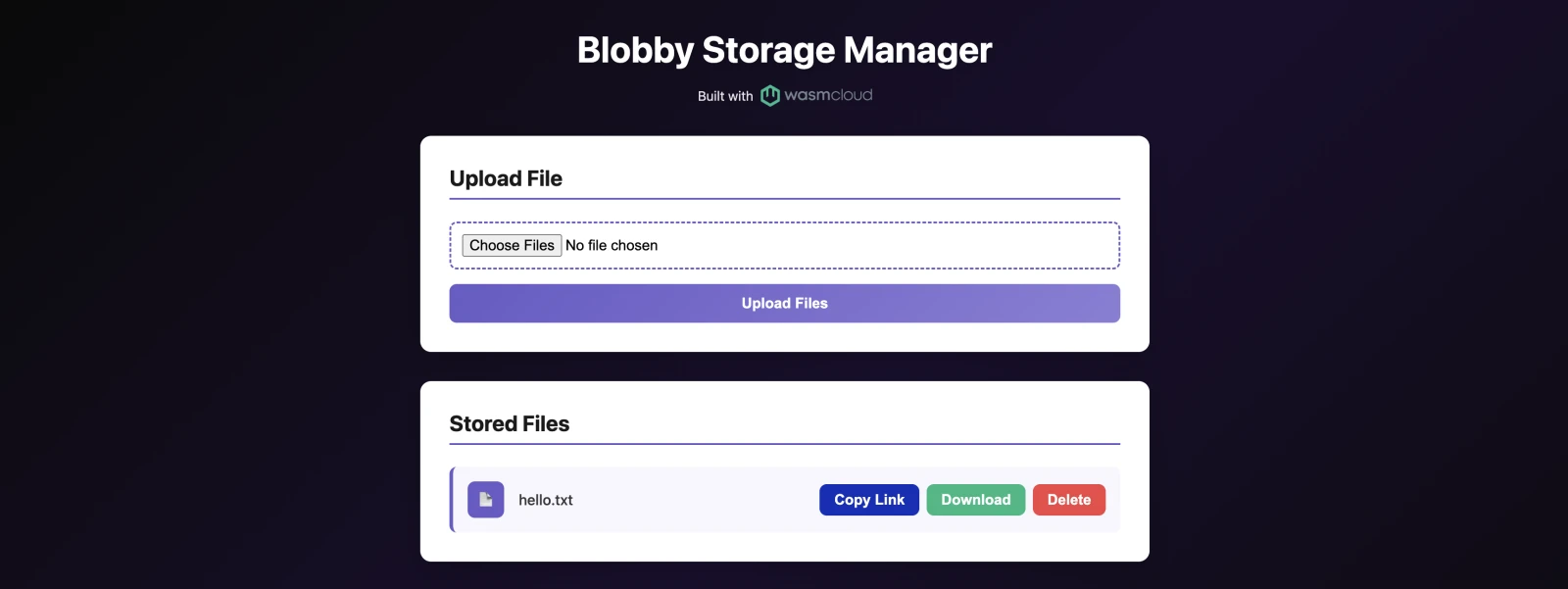
Now let's deploy a more feature-rich example: Blobby ("Little Blobby Tables"), a simple file server that demonstrates the wasi:blobstore capability alongside wasi:http.
Because only one NodePort/LoadBalancer Service can claim the external port at a time, delete the http-hello-world workload and its Service before deploying Blobby:
kubectl delete workloaddeployment http-hello-world
kubectl delete service http-hello-world
The Blobby manifest routes HTTP traffic on blobby.localhost.direct, a public DNS alias for 127.0.0.1, so no /etc/hosts changes are needed. Apply the manifest below to deploy the blobby component alongside a Service of the appropriate type for your environment:
- Existing cluster
- kind
- k3d
- k3s
kubectl apply -f - <<EOF
apiVersion: v1
kind: Service
metadata:
  name: blobby
spec:
  type: ClusterIP
  ports:
    - port: 80
      protocol: TCP
---
apiVersion: runtime.wasmcloud.dev/v1alpha1
kind: WorkloadDeployment
metadata:
  name: blobby
spec:
  replicas: 1
  template:
    spec:
      kubernetes:
        service:
          name: blobby
      hostInterfaces:
        - namespace: wasi
          package: http
          interfaces:
            - incoming-handler
          config:
            host: blobby.localhost.direct
        - namespace: wasi
          package: blobstore
          version: 0.2.0-draft
          interfaces:
            - blobstore
          config:
            buckets: blobby
      components:
        - name: blobby
          image: ghcr.io/wasmcloud/components/blobby:0.6.0
EOFkubectl apply -f - <<EOF
apiVersion: v1
kind: Service
metadata:
name: blobby
spec:
type: NodePort
ports:
- port: 80
protocol: TCP
nodePort: 30950
---
apiVersion: runtime.wasmcloud.dev/v1alpha1
kind: WorkloadDeployment
metadata:
name: blobby
spec:
replicas: 1
template:
spec:
kubernetes:
service:
name: blobby
hostInterfaces:
- namespace: wasi
package: http
interfaces:
- incoming-handler
config:
host: blobby.localhost.direct
- namespace: wasi
package: blobstore
version: 0.2.0-draft
interfaces:
- blobstore
config:
buckets: blobby
components:
- name: blobby
image: ghcr.io/wasmcloud/components/blobby:0.6.0
EOFkubectl apply -f - <<EOF
apiVersion: v1
kind: Service
metadata:
name: blobby
spec:
type: LoadBalancer
ports:
- port: 80
protocol: TCP
---
apiVersion: runtime.wasmcloud.dev/v1alpha1
kind: WorkloadDeployment
metadata:
name: blobby
spec:
replicas: 1
template:
spec:
kubernetes:
service:
name: blobby
hostInterfaces:
- namespace: wasi
package: http
interfaces:
- incoming-handler
config:
host: blobby.localhost.direct
- namespace: wasi
package: blobstore
version: 0.2.0-draft
interfaces:
- blobstore
config:
buckets: blobby
components:
- name: blobby
image: ghcr.io/wasmcloud/components/blobby:0.6.0
EOFkubectl apply -f - <<EOF
apiVersion: v1
kind: Service
metadata:
name: blobby
spec:
type: LoadBalancer
ports:
- port: 80
protocol: TCP
---
apiVersion: runtime.wasmcloud.dev/v1alpha1
kind: WorkloadDeployment
metadata:
name: blobby
spec:
replicas: 1
template:
spec:
kubernetes:
service:
name: blobby
hostInterfaces:
- namespace: wasi
package: http
interfaces:
- incoming-handler
config:
host: blobby.localhost.direct
- namespace: wasi
package: blobstore
version: 0.2.0-draft
interfaces:
- blobstore
config:
buckets: blobby
components:
- name: blobby
image: ghcr.io/wasmcloud/components/blobby:0.6.0
EOFVerify the deployment:
kubectl get workloaddeploymentsOnce running, open http://blobby.localhost.direct in your browser to use the file manager UI:
You can also interact with the file server directly from the command line:
Upload a file:
echo "Hello, wasmCloud!" > hello.txt
curl -H "Content-Type: text/plain" http://blobby.localhost.direct/hello.txt --data-binary @hello.txt
List all files:
curl -X POST http://blobby.localhost.direct/Download a file:
curl http://blobby.localhost.direct/hello.txtDelete a file:
curl -X DELETE http://blobby.localhost.direct/hello.txtClean up
To remove the deployments and their Services created in this tutorial:
kubectl delete workloaddeployment http-hello-world blobby --ignore-not-found
kubectl delete service http-hello-world blobby --ignore-not-found
To tear down the cluster entirely:
- Existing cluster
- kind
- k3d
- k3s
Remove the wasmCloud Helm release:
helm uninstall wasmcloudkind delete clusterk3d cluster delete wasmcloudk3s-uninstall.shWhat's next?
- Explore the interfaces: Learn how WASI interfaces work and browse the full list of built-in capabilities your components can use.
- Go deeper with components: The Developer Guide covers building, publishing, debugging, and composing components.
- Deploy to production: The Operator Manual covers production topics: RBAC, private registries, and CI/CD pipelines.